
In the decades since Naoshima first opened its doors to the world in the early 1990s with the debut of Benesse House Museum, the number of visitors has grown exponentially, with more than a million people stepping off the ferry onto Naoshima in 2025 alone. Among the many who haven’t been yet been but surely want to go one day, people with disabilities around the world have been adding the island to their bucket lists. However, the prospect of traveling through rural Japan can seem daunting to anyone, and information online about coming to Naoshima in a wheelchair is especially lacking.
With that in mind, I’ve put together this article as an appendix to our Ultimate Naoshima Travel Guide, focused on disabled visitors to Naoshima — particularly wheelchair users, though these notes may also be of interest to other visitors with limited mobility. A Naoshima resident since 2019, I have guided a few wheelchair users on the island in recent years; in all cases, we had a great, fulfilling time, but there were definitely some challenges and limitations presented by the art museums and other venues. I have recounted and expanded upon those lessons here, combining them with all of the resources I have been able to gather related to accessible transportation, lodging, and dining.
This is an imperfect document. There are surely things I’ve missed, and it’s also impossible to anticipate all visitors’ needs. Still, if you are a wheelchair user, I hope this guide encourages you to make your way to Naoshima. It’s far from barrier-free here, but it’s a magical corner of the world, and a visit here is a lot less daunting than it may appear, as long as you plan carefully and arrange the support you need.
One recommendation at the start: Setouchi Islander, a boutique travel company based closed to Naoshima, is a fantastic option for those who want a local team to manage their trip. Give them your dates and requirements, and they’ll put together a plan for wheelchair-accessible lodging, dining, and transportation, as well as museum tickets and a local English-speaking guide (like me). They’ll also have great ideas for other areas to explore in the region, if you are open to extending your trip. If you are already working with a travel agent in your country, Setouchi Islander makes a great local partner for arranging all of the logistics here.
Visiting Naoshima in a Wheelchair: Table of Contents
- Getting to and around Naoshima
- Accessible lodging on or near Naoshima
- Accessibility notes for Naoshima museums and art venues
- Dining
- Notes for visitors with other disabilities
- Notes for everybody
Getting to and around Naoshima
Trains to Naoshima (Uno/Takamatsu)
For wheelchair users coming by train (bound for either Uno Station or Takamatsu Station), assistance boarding/disembarking is available by prior request only. Japanese rail car floors are often not aligned with station platforms, so staff will need to fit a small ramp for you to use to roll on or off. You can find information about this service in English, as well as a request form, here. Make your arrangements as early as possible, and read the directions carefully. Uno Port (with ferries to Naoshima) is about 350 meters from Uno Station, and Takamatsu Port (also with ferries to Naoshima) is about 500 meters from Takamatsu Station.
Ferries to Naoshima
The car ferry to Naoshima, from both Uno and Takamatsu ports, is wheelchair accessible. There is an elevator in the boat between the vehicle deck and the passenger deck; enter on the right side in Uno, left side on Naoshima, and the right side (via the vehicle deck, not via the port building) in Takamatsu. The elevator is pretty slow, so make your way to it when the arrival announcement begins to beat the tourists with big suitcases. The high-speed passenger boats are not wheelchair accessible. You can find ferry timetables in our Ultimate Naoshima Travel Guide. Ferry ticket offices in Uno, Takamatsu, and Naoshima (Miyanoura) are all wheelchair-accessible. (There are no accessible toilets at the ports; the ferries themselves do have an accessible toilet.)
Rental cars
For wheelchair users who can drive, or who are traveling with someone who can, a rental car gives you quite a bit of freedom on Naoshima. You can rent one that suits your needs on the mainland and drive on to the ferry to Naoshima from either Uno or Takamatsu. The rental cars available on Naoshima are all compact and not recommended for wheelchair users. You will need a Japanese driver’s license or an international driving permit and translated copy of your international license to rent a car in Japan. I highly recommend working with a Japan-based travel agent to make these arrangements, as there may be special considerations.
- Toyota Rentals Shin-Okayama (JP website) offers a rental van with a wheelchair lift. They have a location near Okayama Station.
- There are several other businesses in Takamatsu and Okayama offering accessible vehicle rentals (福祉車両レンタカー). The challenge is that most of them are not located near train stations or airports. As I learn of more options, I’ll list them here.
Regular taxis
A full-day charter taxi is a worry-free way to explore Naoshima. The taxis that service Naoshima are primarily Toyota Alphard vans which are roomy and comfortable, and a good option if your wheelchair is foldable and you can get in and out of a regular car seat independently (or with assistance from someone else in your party). If you aren’t traveling with a local guide, most taxi drivers in the area are familiar with the names and locations of museums on Naoshima — though their English will be limited. Provide your driver with a printout of your planned itinerary so they can anticipate what you’ll need. You can find information on booking regular taxis in our Ultimate Naoshima Travel Guide, or work with your travel agent.
Accessible taxis
Taxis with lifts or ramps are available in Okayama and Takamatsu. A Japan-based travel agent can help you find the right accessible taxi (福祉タクシー) for your Naoshima visit. Heiwa Taxi is a company I’ve worked with, based in Okayama, that has wheelchair-accessible vehicles and very helpful drivers. Or you might try Welhire, which specializes in arranging accessible transportation for foreign tourists throughout Japan. I haven’t worked with them, but they seem like a great resource.
Buses and museum shuttles
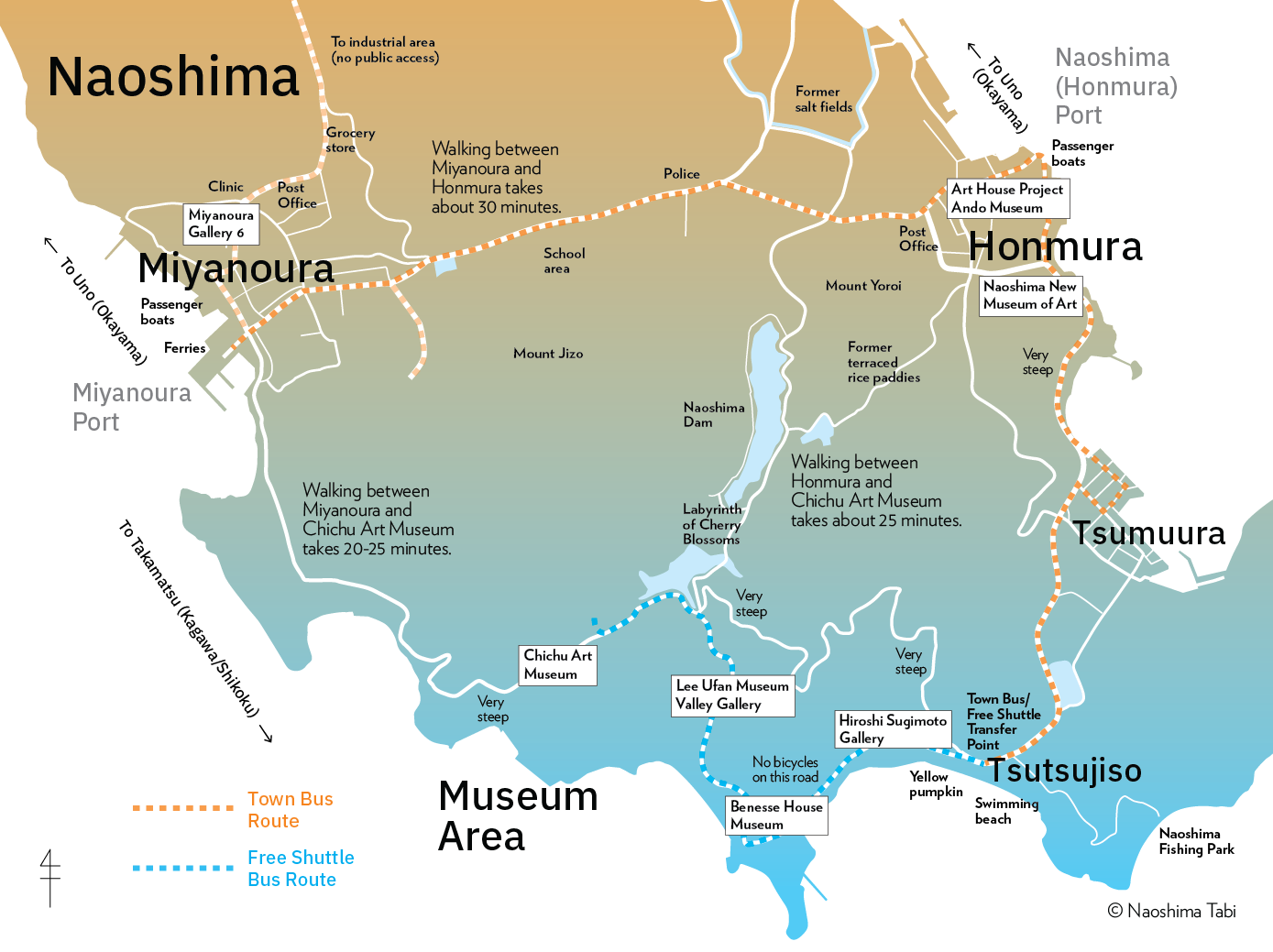
There are several buses operating on Naoshima, all on one route. On the newest (yellow or blue) buses, there is a designated space in the front to store a folded wheelchair. If possible, stop by the Naoshima Tourism Association office (in the Miyanoura Port building) to let them know when you would like to board the bus so they can alert the drivers and hopefully ensure the right bus is available for you. Also, try to board the bus at Miyanoura Port, Nokyo-mae (Honmura village), or Tsutsuji-so, and be at the stop early — this will help minimize crowd-related frustration. The Benesse House courtesy shuttle buses between Tsutsuji-so (the last stop on the public bus) and the museums (Hiroshi Sugimoto Gallery → Benesse House Museum → Lee Ufan Museum → Chichu Art Museum) have a luggage area the front that can accommodate a compact, folded wheelchair. All of the buses on Naoshima require you to step up to board. None of the buses on the island have a ramp or lift.
No transportation
If your wheelchair is powered with a battery that lasts a very long time and can tolerate some uneven terrain, it’s possible to get around the island independently. The simplest path with the lightest traffic involves going south after arriving in Miyanoura Port, up the road to Chichu Art Museum, then on to Lee Ufan Museum and Benesse House Museum, and eventually to Hiroshi Sugimoto Gallery and Yayoi Kusama’s yellow pumpkin. Here is the route via Google Maps. Just note that this route is more than seven kilometers (4.3 miles) round-trip and very hilly. It’s also a rural road with minimal sidewalks, no businesses, and very few passers-by. If you choose this option, I strongly encourage you to travel with someone who can provide assistance if needed. (There may be a manual wheelchair user who wants to attempt this route — it would be a real undertaking. Send me a message.)
Accessible lodging on or near Naoshima
Benesse House
Benesse House, the iconic museum hotel on Naoshima, is mostly accessible for wheelchair users. There are no guestrooms with wheelchair-accessible baths. Otherwise, the rooms are free of steps, and all except Oval can be accessed via elevator. (Oval guests need to take a little monorail to their rooms, and this won’t accommodate a wheelchair.) The Beach suites are particularly spacious. The hotel’s courtesy shuttle bus can load a compact foldable wheelchair but does not have a ramp or lift.
Ryokan Roka
Roka is a luxury inn (ryokan) on Naoshima. The hotel’s common areas, including the restaurant, are wheelchair-accessible. The rooms themselves are not wheelchair-accessible. A high step-up is required to get into the room, after which there are one or two low steps between the sleeping, living, and bathroom/restroom areas. The sunken bath may also be challenging for some to enter and exit (handrails are planned but not yet installed). So this option should only be considered for wheelchair users who are otherwise fit and can make do without wheelchairs in their rooms. Roka’s courtesy shuttle van can load a foldable wheelchair but does not have a ramp or lift.
Uno Hotel
Uno Hotel is located across the street from Uno Station and less than 400 meters from Uno Port. The hotel’s common areas (registration desk, lounge, restaurant) are all fully wheelchair accessible. Most of the guestrooms are wheelchair-accessible as well, and some feature amenities like low-height beds. However, there are no fully-accessible baths (roll-in showers, etc) at the hotel. Uno Hotel is considerably less expensive than the Naoshima options listed above.
JR Hotel Clement Takamatsu / JR Clement Inn Takamatsu
These two hotels are next-door to each other and across the street from Takamatsu Port. Both have a limited number of fully wheelchair-accessible “universal rooms.”
Other accessible lodging options
There are many larger hotels near Okayama Station which are more likely to offer accessible rooms. It’s quite common for Naoshima visitors to come to the island on a day trip from Okayama. The travel time via car or train between Okayama Station and Uno Port is approximately one hour. Takamatsu also has several other large hotels fairly close to the port that may offer accessible rooms.
Accessibility notes for Naoshima museums and art venues
Benesse Art Site Naoshima encourages visitors with disabilities to contact them via their web form for assistance. This is especially important if you are a wheelchair user planning to visit Lee Ufan Museum, but you will also need assistance to enter Naoshima New Museum of Art and Hiroshi Sugimoto Gallery. If you need to request a wheelchair at any of the venues where they are available, you can inquire about those as well. BASN support staff may ask you to provide your full itinerary for the day so they can alert staff at other museums to expect you. (This may result in you getting offered more “help” than you actually want, but please try to be patient with them.)
Benesse House Museum
Mostly wheelchair-accessible, though it can be a bit annoying to navigate for wheelchair users, due to stairs in odd locations that require you to retrace your route. One section of the lowest level is not accessible due to the presence of a few stairs and no ramp. (Valley Gallery, a satellite element of Benesse House Museum that is located near Lee Ufan Museum, is very difficult and potentially dangerous for wheelchair users.)
Accessible toilets: Yes.
Accessible dining: Yes.
Wheelchairs available: Yes (2 available).
Chichu Art Museum
The museum is generally wheelchair-accessible, but two galleries feature (many) stairs as part of the artwork. For both of these galleries, wheelchair users can enter and view the installations in a limited way from the lower area. The staff may suggest you switch to one of their manual wheelchairs — this isn’t required, but if you bring your own wheelchair, staff will need to wipe down your wheels before you enter the Claude Monet room in order to protect the floor. Wheelchair users who are able to stand and walk for short periods may instead opt to enter the Monet room on foot. (You’ll need to swap your shoes for slippers provided by the museum.) Elevators are present but tucked out of the way; pick up a map when you enter so you can find them.
Accessible toilets: Yes.
Accessible dining: Yes.
Wheelchairs available: Yes (2 available).
Naoshima New Museum of Art
Wheelchair-accessible, but the museum is perched on top of a small mountain and requires some persistence to get to. A (steep) private road to the museum is normally off-limits, but disabled visitors can use it to bypass the 96 stairs that people otherwise need to climb to get to the entrance. Here is a Google Maps link to the start of that road. Your taxi or rental car can park at a small upper lot at the end of the private road. From there, a final steep slope lies between you and the front door; wheelchairs may need to cut a zig-zag route to get up there. But once you are finally in the building, it’s probably the most barrier-free museum on the island, as well as one of the most impressive.
Accessible toilets: Yes.
Accessible dining: Yes.
Wheelchairs available: Yes (2 available).
Hiroshi Sugimoto Gallery
Mostly wheelchair-accessible. There is an elevator to get down to the gallery area, but if you are not staying at Benesse House, you need to ask the Benesse House staff to access it, as the upper elevator lobby is inside the hotel area. As with many Tadao Ando-design museums on the island, a few random stairs prevent wheelchair access to one area.
Accessible toilets: Yes.
Accessible dining: Yes. (Tea/sweets service only)
Wheelchairs available: Yes (2 available).
Lee Ufan Museum
This venue can be made wheelchair-accessible upon request — to an extent. There is a foldable ramp that staff members can deploy on short staircases throughout the small museum to temporary render them wheelchair-navigable, though it’s a bit steep. Wheelchair users also need to request access to a road that’s normally closed (visitors normally descend to the museum grounds via a long outdoor staircase). Extensive use of gravel in the museum area is a challenge for wheelchair users. Accessibility was clearly an afterthought for this venue, and it may not be worth the extra effort for some wheelchair users.
Accessible toilets: Yes.
Accessible dining: None.
Wheelchairs available: Yes (1 available).
Art House Project
I often call Art House Project the “soul” of the art collection on Naoshima, and I try to get as many people there as possible. Unfortunately, its rural-village setting presents serious limitations for disabled visitors. None of the seven “art houses” are wheelchair-accessible, as they are either traditional Japanese homes or new buildings on old, quirky historic sites. Honmura village itself, however, is largely navigable by wheelchair. Wheelchair users who are able to stand and walk for periods of up to ten minutes (including climbing/descending a few stairs, sometimes with no handrail) should be able to access Kadoya, Ishibashi, Minamidera, Gokaisho, and Kinza, leaving their wheelchairs outside. (Note that Minamidera and Kinza require timed-entry tickets.) Haisha is difficult to access due to a steep slope and quite a few steep stairs, so I’d leave it off your itinerary. Finally, Go’o Shrine can be accessed by ultra-motivated wheelchair users via only one of the four paths up the hill (the path that begins across the street from the New Museum of Art parking lot — map pin here), but that path is variously steep, narrow, uneven, muddy, and slippery. Also, the underground portion of the shrine is not wheelchair-accessible, so you’ll need to park your wheelchair and walk in.
Accessible toilets: The only wheelchair-accessible toilets in the village are at the port (by the bubble structure).
Accessible dining: None. Some village cafes/restaurants have space to park wheelchairs, so those who can stand and walk briefly and navigate uneven floors/stairs can find options in the village.
Wheelchairs available: Yes (1 available, at Honmura Lounge & Archive).
Miyanoura Gallery 6 / Setouchi “ ” Archive
Motoyuki Shitamichi’s ongoing installation at Miyanoura Gallery 6 is mostly wheelchair-accessible with assistance (front door is at the top of a short ramp and must be pulled open; some sharp turns may be required inside). To reach the gallery you need to go down a narrow and frequently busy road in Miyanoura village.
Accessible toilets: None.
Accessible dining: None.
Wheelchairs available: None.
Other sites
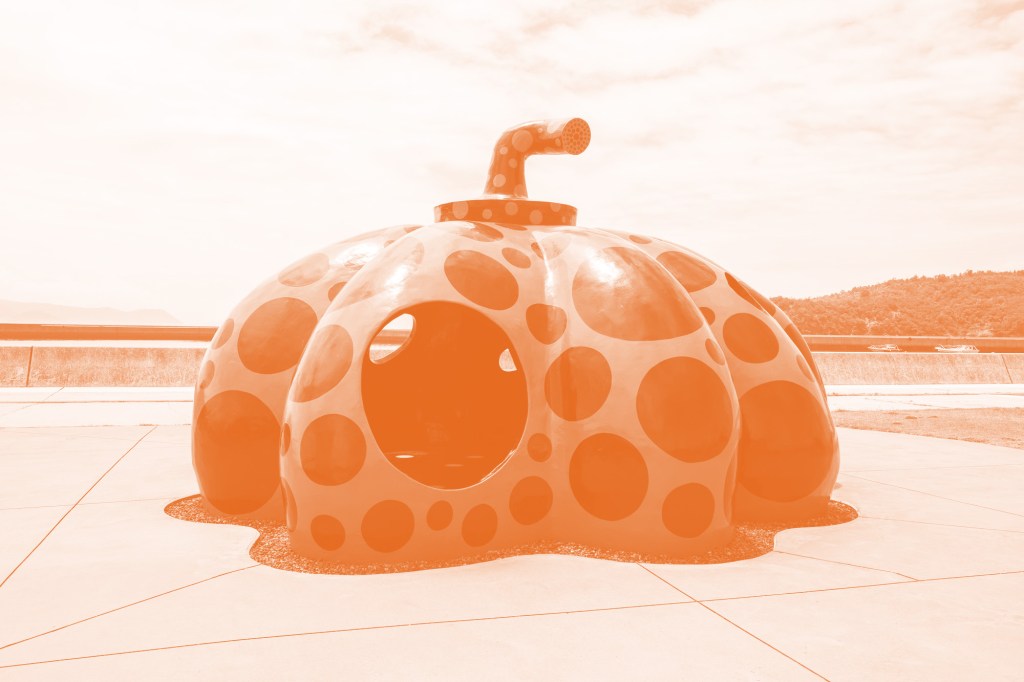
- Yayoi Kusama’s red pumpkin sculpture by Miyanoura Port can be easily accessed (but not entered) via wheelchair. The more-famous yellow pumpkin is located on a pier that you need to cross a short stretch of sandy beach to get to.
- Ando Museum, Ring of Fire, Naoshima Bath “I♥︎湯”, and The Naoshima Plan “The Water” are all not wheelchair-accessible.
Other islands
Teshima Art Museum and Inujima Seirensho Art Museum are nominally wheelchair-accessible (at least it says so on their websites), but there are some serious logistics to contend with on both islands. Teshima is very spread out — wheelchair users absolutely need a car, either a rental or a charter taxi — and the museum floor is specially treated, so the museum staff may require you to transfer to one of their wheelchairs and be pushed around. The boat to Inujima is not wheelchair-accessible, the island has a lot of uneven terrain, and the museum itself has very uneven floors. If you plan to visit either island in a wheelchair you will need to plan very carefully.
Dining
The most-accessible lunch options on Naoshima are the cafes at Benesse House Museum (“Museum Cafe” on the website) or Naoshima New Museum of Art — you’ll have no trouble getting a wheelchair to a table. Museum Restaurant Issen is another accessible option at Benesse House Museum. Chichu Art Museum is wheelchair-accessible, but their cafe is smaller and often crowded. Finally, the cafeteria at the General Wellness Center (Fukushi Center) above Miyanoura village is wheelchair-accessible.
Most other options are only suitable for patrons who can stand and walk short distances, including a few steps up/down with no handrails. Many cafes/restaurants in Honmura village (Art House Project/Naoshima New Museum of Art area) and Miyanoura village have space outside where you can park a wheelchair — they’re just mostly in old houses that require you to step up from ground level to enter.
Wheelchair-accessible dinner options on Naoshima are currently limited to Benesse House’s and Roka’s hotel restaurants (guests only). Other restaurants open for dinner in the villages have the same disclaimer as above: You’ll have to park your wheelchair (if there is space outside) and walk inside. Uno Hotel has a wheelchair-accessible restaurant that’s open to the public for dinner.
Notes for visitors with other disabilities
All museums and art facilities on Naoshima allow access for service dogs (e.g. seeing-eye dogs or hearing-assistance dogs).
The town buses and ferries have priority seats available for disabled and elderly passengers. When possible, board at Miyanoura Port, Nokyo-mae (Honmura village), or Tsutsuji-so, and arrive early for the bus. You can find the bus schedules in our Ultimate Naoshima Travel Guide.
Many of the facilities on Naoshima require you to take off your shoes in certain areas. Sometimes benches are provided, but in a few places (notably, Art House Haisha) there is nowhere to sit, and in others (Chichu Art Museum – James Turrell area, Art House Kadoya) there is only one small chair available. Museums aside, many cafes and restaurants and some guesthouses also require you to take off your shoes. I highly recommend wearing shoes that are easy to slip off and on, particularly if you have limited mobility.
Notes for everybody
Check the Benesse Art Site Naoshima calendar to make sure you know what is open during your planned visit. Most things on Naoshima are closed on most Mondays!
Book tickets for all the venues you plan to visit as early as possible. Tickets go on sale at 10:00 JST on the second Friday of the month, two months prior. (So, tickets for March become available on the second Friday in January.)
- Certain venues, notably Hiroshi Sugimoto Gallery and Chichu Art Museum, require you to book an entry time. Make sure your itinerary is realistic.
- Make sure you can log into the Benesse Art Site Naoshima tickets portal on your smartphone to access your tickets during your visit. The “My QR Code” button at the top of the page will get you into everything except Naoshima New Museum of Art. That museum requires you to scan its museum-specific ticket(s).
- If you don’t use a smartphone (or if you want to be on the safe side), print out the QR code tickets from the website (and the “My QR Code”) and bring them with you.
- Don’t use the QR code tickets that are emailed to you. Use the ones on the website.
Check out our Ultimate Naoshima Travel Guide for more information about visiting the island, including information on the museums, ferry and bus schedules, and travel tips.
Finally, consider hiring a local guide. We offer the knowledge we’ve absorbed over years living out here to add nuance, context, and delight to your visit, and also manage the on-the-day logistics so you don’t have to think about it. You can find information about my tours here. If I am not available, I am happy to try to connect you to someone else who is.
Are you a traveler with a disability who is planning your trip to Naoshima and have a question I can answer? Or have you been to Naoshima already and think I missed something? Or did you spot an error? Please leave a comment.

 Naoshima Tabi
Leave a comment