
Japan’s “art islands” represent a growing phenomenon in the Seto Inland Sea area (or Setouchi): a flourishing of contemporary art and architecture set against spectacular scenery. From tiny islands with a handful of residents to large islands with tons to see and do, each art island offers a unique experience to visitors, often blending contemporary art with ancient cultural traditions.
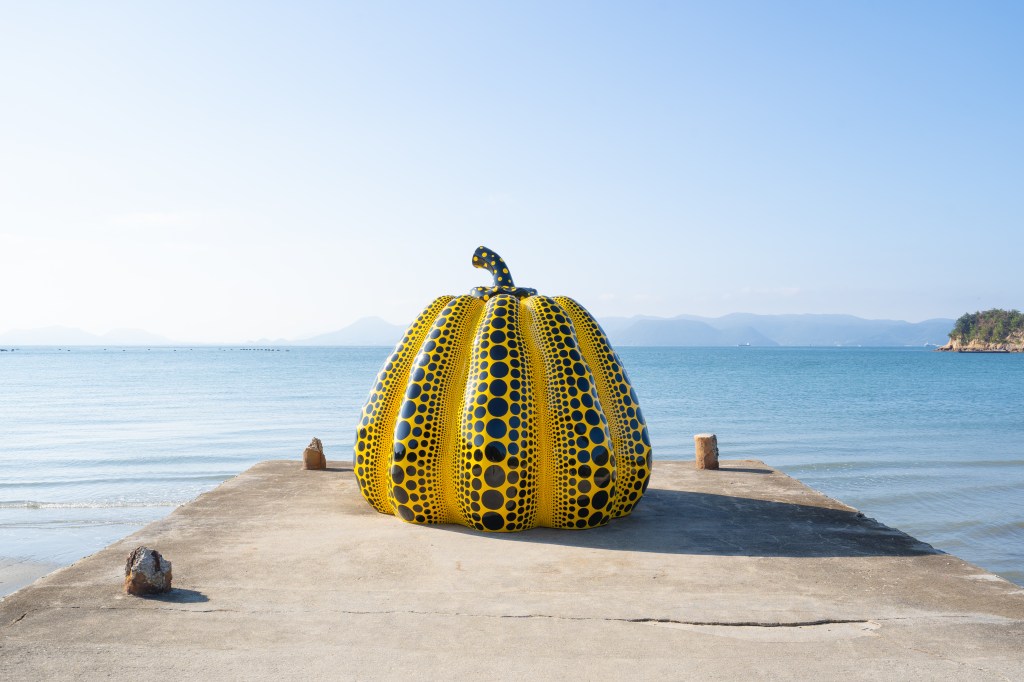
A photo of a large yellow pumpkin sculpture on the end of a pier with the sea in the background.
“Pumpkin” by Yayoi Kusama on Naoshima.

This guide introduces Naoshima, the first and most popular “art island.” We also introduce nearby islands that are easy to get to from Naoshima. While this guide covers islands that are part of the Setouchi Triennale, it is not a Triennale guide. Instead, here you’ll find information that is useful whenever you visit. This guide originally appeared on the Art Island Center website, but has been updated and moved here.

Contents

  1. Naoshima overview
  2. What to do on Naoshima
  3. Other islands
    Teshima
    Inujima
    Megijima & Ogijima
  4. When to visit
  5. Transportation
    Naoshima Ferries
    Naoshima Bus & Shuttles
    Naoshima Bicycles
    Naoshima Taxis
    Teshima Ferries
    Teshima Bus
    Teshima Bicycles
    Teshima Taxis
    Megijima/Ogijima Ferries
  6. Lodging
    – Hotels on Naoshima
    – Guesthouses on Naoshima
    – Hotels & guesthouses at nearby ports
    – Guesthouses on Teshima
  7. Dining

Naoshima overview

Naoshima is a small island in the eastern Seto Inland Sea, halfway between Hiroshima and Osaka. It has been the site of major art-related development since the early 1990s and now hosts several museums by Pritzker Prize-winning architect Tadao Ando. The island’s collection includes major artworks by internationally celebrated artists like Claude Monet, James Turrell, Yayoi Kusama, and Hiroshi Sugimoto. Other highlights include artworks taking the forms of a functioning bathhouse and a Shinto shrine, blurring the boundary between art and life. Its troupe of all-women bunraku puppeteers is unique to Naoshima.
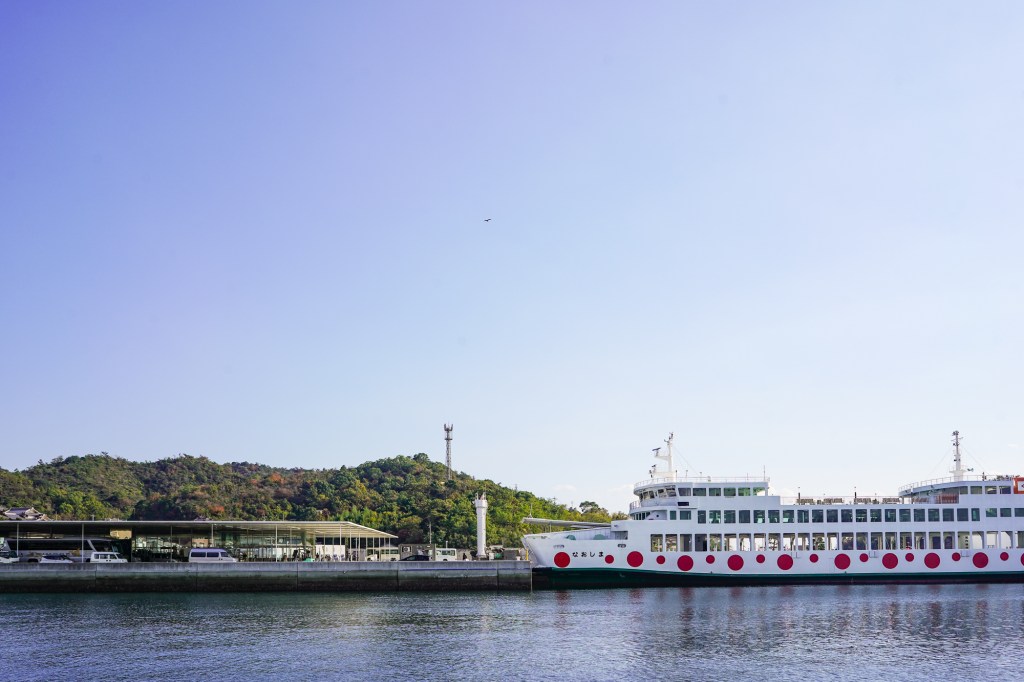
A photo of a large ferry with red polka-dots, docked at a forested island port.
Miyanoura Port on Naoshima. Photo by Andrew McCormick.

Despite its small size, Naoshima has a surprisingly varied mix of cafes and restaurants, featuring local fish burgers, artisan pizza, and gelato, as well as classic Japanese fare like sushi and okonomiyaki. Visitors who spend the night on Naoshima can choose from luxury rooms on the museum grounds, traditional guesthouses, or even Mongolian yurts on the island’s southern shore.

While the north side of the island holds a sprawling factory campus, the southern end is lush and green, with nice beaches and a few hidden nature trails. The island’s ports also offer direct connections to two neighboring “art islands,” Teshima and Inujima.

What to do on Naoshima

The main attraction on Naoshima is its collection of art museums. These are the highlights.

A photo of a concrete wall with the text "Chichu Art Museum."
The entrance to Chichu Art Museum. Photo by Andrew McCormick.

Chichu Art Museum

“Chichu” means “underground,” and the museum lives up to its name: cavernous concrete spaces cut into the mountain, with galleries devoted to Claude Monet, James Turrell, and Walter De Maria. It is an utterly unique environment, windowless save for large openings to the sky above. The museum is mostly lit by nature, so your experience changes based on the season. For example, in the Monet room, a series of the artist’s water lily paintings representing different weather-moods (gloomy overcast, cheerful springtime) are further augmented by the indirect daylight filtering down from above. [Official website]

A photograph of an old house filled with a pool of dark water, within which many small, glowing numbers are visible.
Art House “Kadoya” on Naoshima, with artwork by Tatsuo Miyajima. Photo by Andrew McCormick.

Art House Project

A former dentist’s office, a former wealthy salt merchant’s home, the site of a former temple—once abandoned, now reborn as artwork. Art House Project is a collection of seven traditional houses and religious sites in Honmura that were renovated to marvelous effect by renowned artists and architects. A glass staircase at Go’o shrine descends to a secret cavern underground; a waterfall mural in a former storeroom reflects magically in the lacquered floor; and a James Turrell artwork at Minamidera emerges from the darkness as your eyes slowly adjust. [Official website]

A photo of a large artwork made of neon lights, featuring many short phrases, such as "cry and die" and "feel and live."
“100 Live and Die” by Bruce Nauman at Benesse House Museum. Photo by Andrew McCormick.

Benesse House Museum

The museum that started it all when it opened in 1992, Benesse House Museum displays a small but dazzling collection of artworks by renowned international and Japanese artists. Permanent features include 100 Live and Die (1984), a monolithic Bruce Naumann neon installation centered within a circular, two-story atrium, as well as several large, site-specific works by Yukinori Yanagi, Richard Long, and Hiroshi Sugimoto. Other artwork in rotation includes paintings by David Hockney, Jean-Michel Basquiat, and Jennifer Bartlett. [Official website]

A photo of a concrete chamber filled with reflective stainless steel balls.
Valley Gallery, with an installation by Yayoi Kusama. Photo by Andrew McCormick.

Valley Gallery

Naoshima’s newest gallery opened in 2022. It’s a small Tadao Ando-designed space that is open to the elements, nestled in a valley behind a small pond. Currently its angled walls host Yayoi Kusama’s infamous Narcissus Garden artwork, originally conceived in the 1960s. Hundreds of polished steel spheres not only fill the gallery but spill out onto the surrounding grounds and float whimsically in the pond. Also on display is Tsuyoshi Ozawa’s Slag Buddhas 88 installation, featuring holy figures cast from industrial waste. Admission is complimentary for Benesse House Museum visitors. [Official website]

A photograph of a cube-shaped building with a grid of square windows on the front. The glass doors are adorned with large black letters that say "CINEMA NAOSHIMA."
Miyanoura Gallery 6 on Naoshima. Photo by Andrew McCormick.

Miyanoura Gallery 6

Formerly the island’s lone pachinko parlor, the vacant space was converted into a gallery by architect Taira Nishizawa, and since 2019 has been the site of an ongoing project by artist Motoyuki Shitamichi. Shitamichi’s project, titled Setouchi “     “ Archive, is a living laboratory and a unique example of socially engaged art on Naoshima. Rotating exhibits document aspects of the region’s history, with past iterations focusing on tourism, industry, and local photographers. [Official website]

A photograph of a building covered in a huge assortment of unusual materials, such as colored tiles, mismatched columns, a light fixture in the shape of a nude woman, and a piece of an entirely different building perched on top.
Naoshima Bath “I♥湯” on Naoshima. Photo by Andrew McCormick.

Naoshima Bath “I♥湯”

Take a bath with the locals in one of the weirdest and most-cherished pieces of art in the region. The creation of artist Shinro Ohtake, I♥湯 is a public bathhouse near the island’s main port in Miyanoura. The title for the facility is pronounced “I Love Yu,” with yu the Japanese word for hot water. The building’s exterior is a riot of clashing elements, including entire chunks of other buildings that were brought in and stuck on top of the existing structure. Inside, a large elephant statue peers at bathers beneath a high ceiling painted by the artist. Be sure to brush up on bathing etiquette before you go. [Official website]

Art Island Center. Photo by Andrew McCormick.

Art Island Center

Art Island Center is a gallery, bookshop, and art center in Miyanoura.

The Center also hosts exhibits by Japanese and international artists, photographers, and illustrators. Its shop carries a range of books about art and other topics, as well as stationery and regional gifts. [Official website]

Other points of interest

Other art spots on Naoshima include the Lee Ufan Museum, the Ando Museum, the Hiroshi Sugimoto Gallery, and outdoor artworks across the island including Yayoi Kusama’s red and yellow pumpkins as well as Naoshima Pavilion by architect Sou Fujimoto.

Beyond the big names, there are plenty of homegrown sites of interest. Check out Tofu Gallery, a small gallery across the street from New Olympia restaurant in Miyanoura, where accomplished local painter Tyler Stenlund displays his work. Or pop into the Naoshima town office and see the display of bunraku puppets and photographs of the island’s famed women puppeteers in the lobby (open weekdays).

Other islands

Thanks in large part to the Setouchi Triennale, there are now twelve islands in the eastern Seto Inland Sea featuring artwork. Here are four that you can easily reach from Naoshima, including two (Teshima and Inujima) that have museums accessible most of the year, and two others (Ogijima and Megijima) that have less art on non-Triennale years but are worth a visit regardless.

TIP: Check out David Billa’s blog Setouchi Explorer for in-depth articles about all of the Setouchi “art islands.”

“Memory of Lines” by Chiharu Shiota on Teshima. Photo by Andrew McCormick.

Teshima

Teshima Art Museum is a sublime artist-architect collaboration (Rei Naito and Ryue Nishizawa, respectively): a breathtaking exercise in restrained simplicity contrasted with impossible engineering, surrounded by rice paddies and the sparkling sea.

In the port village of Ieura, Teshima Yokoo House is an old house and surrounding buildings that have been radically transformed by artist Tadanori Yokoo. Under the theme of “the Island of Death,” a collection of the artist’s paintings have been re-envisioned as a funeral for Soichiro Fukutake, the principal arts patron on the three main islands (and who, it should be noted, is not dead).

Other art sites on the island include an impressive “readymade” by Shinro Ohtake, a captivating sculptural work by Taiwanese artist Lin Shuen Long on the island’s southern beach, an installation of red threads by Chiharu Shiota in an old house (weekends & holidays only), and a theater operated by the experimental duo Usaginingen. At Shima Kitchen, diners join an ongoing relational art project that brings together tourists, elderly residents, and young volunteers.

A photo of a low, contemporary granite-stone and glass structure with a tall, much-older smokestake emerging from it.
The exterior of Inujima Seirensho Art Museum. Photo by Andrew McCormick.

Inujima

A tiny island off mainland Okayama Prefecture, Inujima’s Seirensho Art Museum is the spectacular result of a collaboration between artist Yukinori Yanagi and architect Hiroshi Sambuichi. The infamous author and firebrand Yukio Mishima features dramatically in Yanagi’s installation, a sort of otherworldly third contributor. The result is a tense atmosphere of contraditions and competing priorities that somehow coalesces into perfection—truly unforgettable.

The island also features “art houses” with rotating installations by other significant artists like Olafur Eliasson and Kohei Nawa. 

Megijima & Ogijima

Megijima and Ogijima are a pair of islands off Takamatsu Port that host a collection of intimate art installations, including outdoor works and converted, previously-empty homes. Check the Setouchi Triennale calendar for opening times.

Megijima’s sites of interest include a theater built in an old warehouse by artist Yoichiro Yoda. The island is also famous for its “Oni Caves” at the far end of the island.

Ogijima’s small village, perched on the side of a mountain, includes a winding labyrinth of sometimes nearly-vertical streets. Ogijima Library, a community-built project, is a meeting place for creative minds from around the region. A growing collection of creative small businesses by recent migrants gives the little island an exciting atmosphere.

When to visit

Summer is a busy season on the islands, with lots to see and do. If you don’t mind the heat and the occasional crowd, it’s a fun time to explore the sights, swim at the beach, or just hang out by Yayoi Kusama’s Red Pumpkin and watch the sun set behind the Great Seto Bridge. Summer visitors should book accommodation as early as possible, as rooms regularly sell out.

Spring and fall are the most crowded—for a reason. Spring is beautiful on the islands, particularly if you come when the cherry blossoms and mountain azaleas are blooming. Except for the national Golden Week holiday, it’s often less busy than the summer.

In the fall, when the weather cools, you might be lucky enough to catch the autumn festival on Naoshima, which occurs throughout October and features taiko-drumming boys carried around on wooden palanquins.

Unlike many of the other art islands, Naoshima’s museums are open year-round, except for a short maintenance period in the winter. This is also true for the main attractions on Teshima and Inujima, though maintenance periods vary by island. This means that winter can be a great time to check out popular sites like Chichu Art Museum; on weekdays you might even have the place virtually to yourself.

Before committing to an itinerary, be sure to check the official Benesse calendar to see what’s open.

Transportation

Getting here and getting around: here’s all you need to know* about the area’s ports, ferries, and buses.

* While we do our best to keep this information up-to-date, you should double-check with applicable transit providers whenever possible.

Naoshima Ferries

Information: Shikoku Kisen website

You can reach Naoshima via the mainland ports of Uno (Okayama Prefecture) and Takamatsu (Kagawa Prefecture). There are two ports on Naoshima: the larger Miyanoura Port on the west side, and the smaller Naoshima Port in Honmura on the east side. Miyanoura Port connects to both Takamatsu and Uno via both large car ferries and high-speed passenger boats. There is only limited passenger boat service between the port in Honmura and Uno.

There is also a passenger boat running between Naoshima (Miyanoura Port), Teshima (Ieura Port), and Inujima. This boat runs only three times per day and can get crowded on weekends and Mondays.

For complete schedule and fare information, visit the Shikoku Kisen website.

Naoshima Bus & Shuttles

Naoshima Bicycles

Naoshima Taxis

Teshima Ferries

Information:
Teshima Tourism Navi (Uno – Ieura – Karato – Tonosho)
Teshima Ferry (Ieura – Honmura on Naoshima – Takamatsu)
Shikoku Kisen (Miyanoura on Naoshima – Ieura – Inujima)

Teshima has two ports on the north side of the island: Ieura Port (west) and Karato Port (east). A regular service alternating between slow car ferries and high-speed passenger boats connects both ports on Teshima to Uno Port (Okayama Prefecture) to the west, as well as to Tonosho Port on Shodoshima island, which is further east.

There is also high-speed boat service between Ieura Port on Teshima and Takamatsu (Kagawa Prefecture). Very infrequently, this service also stops at Naoshima Port (Honmura).

Shikoku Kisen also offers a thrice-daily boat between Naoshima (Miyanoura Port), Teshima (Ieura Port), and Inujima.

Teshima Bus

Teshima Bicycles

Teshima Taxis